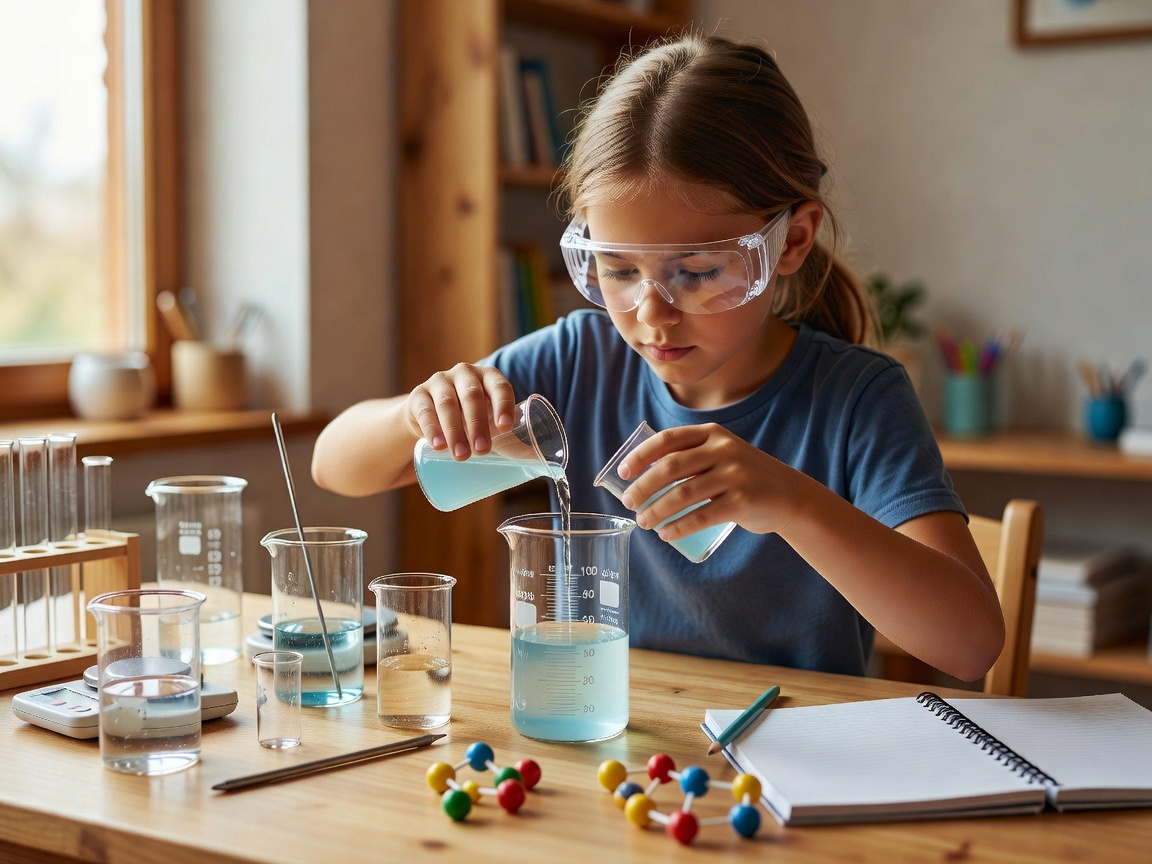
Why Hands-on Discovery Trumps Rote Memorization
Science at its core is not a textbook collection of established facts; it is an active method of questioning, hypothesizing, observing, and drawing reasoned conclusions. In a homeschool environment, science has the luxury of stepping outside sterile classroom worksheets and engaging directly with physical nature.
Below are three reproducible, high-impact science laboratories designed to teach rigorous concepts—osmosis, capillary action, and density stratification—using safe household ingredients.
Experiment 1: The Walking Water Capillary Action Race
Scientific Principle: Adhesion, Cohesion, and Plant Capillary Action.
- Materials: 6 clear cups, water, red, yellow, and blue food coloring, paper towel strips.
- Method: Line cups in a row. Fill cups 1, 3, and 5 with colored water. Leave cups 2, 4, and 6 empty. Bridge adjacent cups with folded paper towels.
- Observations: Water molecules adhere to the cellulose fibers in the paper towel and pull adjacent water molecules through cohesive hydrogen bonding, transferring water into empty cups and mixing secondary colors.
Experiment 2: Density Column Tower & Buoyancy
Scientific Principle: Mass per unit volume (Density = Mass / Volume) and Archimedes' Buoyancy.
Experiment 3: Lima Bean Embryo Dissection & Botany Journaling
Scientific Principle: Angiosperm seed anatomy, cotyledons, and early seedling respiration.
Soak dried lima beans in warm water for 12 hours. Carefully split the seed coat (testa). With a hand magnifying lens, children can observe the intact baby plant (the plumule and radicle) resting between the two food-storing cotyledons. Have students sketch and label each part in their homeschool nature journal.
The Scientific Method Lab Template
Encourage your student to write down each step using standard empirical documentation:
- The Question: What do we want to discover? (e.g., "Will seeds germinate faster in darkness or indirect sunlight?")
- Hypothesis: "If we supply constant moisture and warmth, then seeds in the dark will germinate just as quickly because photosynthesis only occurs after leaves sprout."
- Controlled Variables: Temperature, moisture, seed variety.
- Independent Variable: Light exposure.
- Conclusion & Error Analysis: Evaluating what surprised us during the test.
For additional accredited science curricula, we recommend referencing materials from the NASA STEM Engagement Portal and the Royal Society of Chemistry Educational Library.